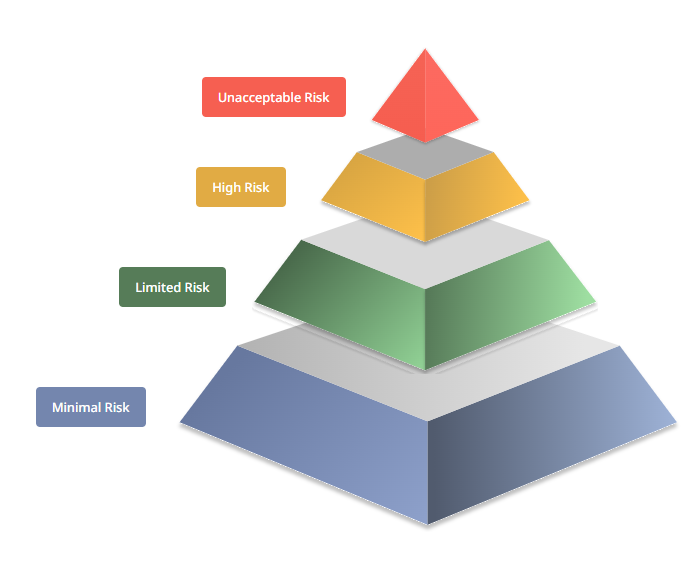
The pioneering regulatory approach to AI, based on a risk-based framework of the AI Act. This framework classifies AI systems into four categories of risk, structured like a pyramid: the higher the risk, the stricter the regulation. At the top of the pyramid are AI systems that pose an unacceptable risk to people's rights and safety. Those are banned entirely under the AI Act, with limited exceptions.
AI Act
The AI Act
The EU Artificial Intelligence Act (Regulation (EU) 2024/1689) is the world’s first comprehensive regulation designed to regulate artificial intelligence across the European Union. It establishes a risk-based framework to ensure that AI systems are safe, transparent, and aligned with fundamental rights and European values.
The Act sets out clear obligations for all those involved in the AI lifecycle, from developers and providers to users, importers, and distributors, and introduces a four-level risk classification
Unacceptable
High
Limited
Minimal risk
Unacceptable-risk AI systems, such as those that manipulate human behavior or enable social scoring, are strictly prohibited. High-risk AI applications, including those used in education, healthcare, employment, and critical infrastructure, are subject to robust requirements for transparency, oversight, and data quality.
Purpose
The EU AI Act aims to:
Ensure that AI systems are safe, ethical, and respect human rights
Provide legal clarity and uniform standards for organizations developing or using AI in the EU
Foster trust and innovation, allowing AI to flourish responsibly
Protect individuals and society from harmful, biased, or discriminatory AI practices
Scope
The Act applies broadly across the AI ecosystem, covering:
Providers, deployers, importers, and distributors of AI systems within the EU
AI used in products, services, and public administration, including key sectors such as healthcare, finance, education, transportation, and law enforcement
AI systems offered by organizations outside the EU, if the systems are used or have an effect within the EU single market
Why It Matters
The EU AI Act marks a historic step toward responsible and human-centric AI governance. By balancing innovation with accountability, it positions the European Union as a global leader in shaping ethical AI standards, ensuring that the technology serves people, not the other way around.
Framework
Legal Documents

This section provides direct access to all official legal documents related to the European Union's Artificial Intelligence Act (AI Act). Here, you will find the full text of the regulation, legislative proposals, amendments, impact assessments, and related guidance issued by EU institutions. These resources are essential for understanding the legal framework governing the development, deployment, and use of artificial intelligence across the EU.