All Pages - Design One -parallax image

What is AI Act?

The AI Act — formally the Artificial Intelligence Act — is a landmark European Union regulation that sets out rules for the development, use, and marketing of artificial intelligence (AI) systems in the EU.

It is the first comprehensive AI law in the world, aiming to promote trustworthy AI while protecting fundamental rights, health, safety, and democracy.

All Pages - Design One -stable image

What is AI Act?

The AI Act — formally the Artificial Intelligence Act — is a landmark European Union regulation that sets out rules for the development, use, and marketing of artificial intelligence (AI) systems in the EU.

It is the first comprehensive AI law in the world, aiming to promote trustworthy AI while protecting fundamental rights, health, safety, and democracy.

Inside Pages Intro - id: 2

What is a Market Surveillance Authority?

A Market Surveillance Authority is a national body responsible for ensuring that products available in the market comply with relevant safety, health, environmental, and consumer protection laws. Its role is to monitor and enforce compliance with national and European Union regulations, safeguarding consumers and maintaining fair competition among businesses. Through inspections, testing, and collaboration with customs and other regulatory bodies, the authority helps prevent the circulation of dangerous or noncompliant products in the marketplace.

As defined in AI Act:
Market Surveillance Authority means the national authority carrying out the activities and taking the measures pursuant to Regulation (EU) 2019/1020 (Article 3 (26))

Inside Pages - Text Boxes - id: 3

Text Boxes

What is Lorem Ipsum?

Lorem Ipsum is simply dummy text of the printing and typesetting industry. Lorem Ipsum has been the industry's standard dummy text ever since the 1500s, when an unknown printer took a galley of type and scrambled it to make a type specimen book. It has survived not only five centuries, but also the leap into electronic typesetting, remaining essentially unchanged.

What is Lorem Ipsum?

Lorem Ipsum is simply dummy text of the printing and typesetting industry. Lorem Ipsum has been the industry's standard dummy text ever since the 1500s, when an unknown printer took a galley of type and scrambled it to make a type specimen book. It has survived not only five centuries, but also the leap into electronic typesetting, remaining essentially unchanged.

What is Lorem Ipsum?

Lorem Ipsum is simply dummy text of the printing and typesetting industry. Lorem Ipsum has been the industry's standard dummy text ever since the 1500s, when an unknown printer took a galley of type and scrambled it to make a type specimen book. It has survived not only five centuries, but also the leap into electronic typesetting, remaining essentially unchanged.

What is Lorem Ipsum?

Lorem Ipsum is simply dummy text of the printing and typesetting industry. Lorem Ipsum has been the industry's standard dummy text ever since the 1500s, when an unknown printer took a galley of type and scrambled it to make a type specimen book. It has survived not only five centuries, but also the leap into electronic typesetting, remaining essentially unchanged.

Listings Text - id: 4

Purpose of the AI Act

Purpose of the AI Act
  • Ensure AI systems are safe and respect EU values

  • Create legal certainty for businesses using AI

  • Promote innovation while minimizing risk

  • Protect people from harmful or discriminatory AI applications

Scope: Who and What Is Affected?

  • Applies to providers, deployers, importers, and distributors of AI systems in the EU

  • Covers AI systems used in products, services, public administration, and more — including healthcare, finance, education, and law enforcement

  • Applies regardless of whether the provider is based inside or outside the EU, as long as the AI is used within the EU market

Inside Pages - Grey Boxes Columns - id 5
What Is a Notifying Authority?

What Is a Notifying Authority?

As defined in the AI Act in Article 3 (19):
‘Notifying authority’:  is the national authority responsible for setting up and carrying out the necessary procedures for the assessment, designation and notification of conformity assessment bodies and for their monitoring."

Legal Basis

Legal Basis

The designation of a Notifying Authority is mandatory for all EU Member States under the AI Act. It ensures that the notified bodies assessing the conformity of AI systems possess the necessary technical competence, impartiality, and independence as defined by the regulation.

The authority operates under the principles and requirements set out in:

  • Chapter IV of the AI Act
  • EU legislation on accreditation and market surveillance
  • National laws transposing the AI Act into domestic legal systems
Our Role

Our Role

As the Notifying Authority in Cyprus, we are officially empowered to:

  • Establish and implement procedures to assess and designate conformity assessment bodies
  • Notify those bodies to the European Commission and other Member States
  • Monitor and supervise the ongoing performance of notified bodies to ensure compliance
  • Withdraw or suspend designations where necessary
  • Ensure transparency, impartiality, and competence in the national conformity assessment system
Working with Conformity Assessment Bodies

Working with Conformity Assessment Bodies

Conformity assessment bodies (CABs) are independent organizations that verify whether high-risk AI systems comply with the requirements of the AI Act. Before they can operate, these bodies must be:

  • Assessed for competence and impartiality
  • Designated by us, the Notifying Authority
  • Notified at the EU level to be officially recognized

We provide the framework and oversight that allows these bodies to function effectively and in full compliance with European legislation.

Our Commitment

Our Commitment

Our goal is to ensure a robust, trustworthy, and harmonized system of AI oversight that:

  • Protects public interest and fundamental rights
  • Supports innovation within clear and consistent legal boundaries
  • Promote coordination and information-sharing across the EU

We uphold the principles of transparency, competence, and independence in all our operations.

Tools Boxes - id: 6

Tools

Self Assessment Tool

Self Assessment Tool

Self Assessment Tool

Self Assessment Tool

Timeline - id: 7

Timeline of the AI Act

  1. 02/02/2025

    The following 02/08/2025 02/08/2026 Provisions stared to apply:
    > Prohibited AI Systems (art.5)
    > AI system definition (art. 3(1))
    > AI literacy (art.4)

  2. 07/03/2025

    Commission established the rules on the set-up of a scientific panel of experts (arts 68 & 69)

  3. 02/05/2025

    Code of practice on general-purpose AI (GPAI) models (art. 65)

  4. 02/08/2025

    The following Provisions stared to apply: 

    > GPAI models (chapter 5)
    > Notified Bodies (chapter 3, section 4)
    > Governance (chapter 7)
    > Confidentiality (art. 78)
    > Penalties (art. 99 & 100)

  5. 02/02/2026

    General date of application of the AI Act. The AI Act stars to apply to AI systems placed on market before this date only if these systems are subject to significant changes in their designs from the date onwards (art. 111 (2)), except the provisions on high-risk AI systems (art. 6 (1) & 113, annex I).

  6. 02/08/2026

    AI Act provisions on highrisk AI systems under harmonised AU law start to apply (arts. 6 (1) & 113, annex I)

Text - Popup Image id: 8

What is AI Act?

The AI Act — formally the Artificial Intelligence Act — is a landmark European Union regulation that sets out rules for the development, use, and marketing of artificial intelligence (AI) systems in the EU.

It is the first comprehensive AI law in the world, aiming to promote trustworthy AI while protecting fundamental rights, health, safety, and democracy.

Expanding Cards - id: 9

AI Board

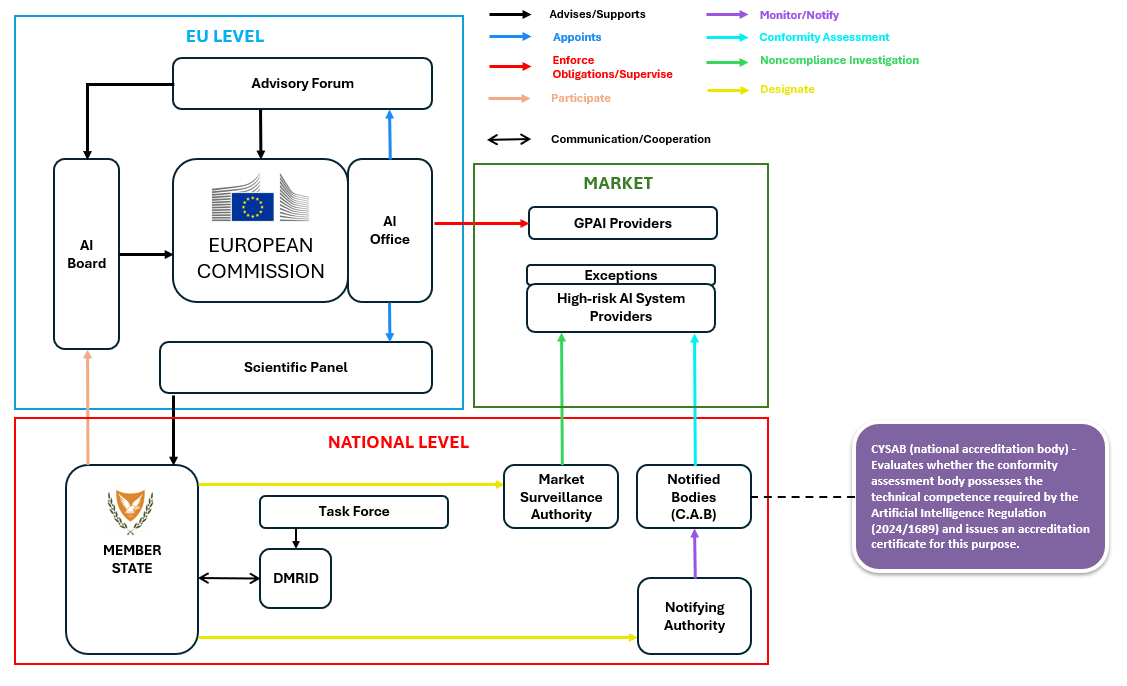
The AI Board is composed of representatives from each Member State and is supported by the AI Office, which serves as its secretariat. The Board plays a central role in coordinating implementation throughout the EU by:

  • Providing advice and assistance on the Regulation’s application,
  • Discussing and developing implementation guidelines,
  • Coordinating national competent authorities, and
  • Exchanging technical and regulatory expertise.

AI Office

The AI Office, established as a European centre of expertise in artificial intelligence, oversees the enforcement of the Regulation and ensures its uniform application across all EU Member States. It supports the governance bodies in their tasks and acts as the competent market surveillance authority for general-purpose AI models.

Advisory Forum

The Advisory Forum brings together a broad range of stakeholders including startups, SMEs, academia, and non-commercial organizations, offering technical expertise and advice to the AI Board.

Scientific Panel

The Scientific Panel, composed of independent experts in AI, provides technical guidance to the AI Office and national authorities on applying the Regulation’s requirements, particularly concerning general-purpose AI models.

Design Ten - id:10

What is Lorem Ipsum

Lorem Ipsum is simply dummy text of the printing and typesetting industry. Lorem Ipsum has been the industry's standard dummy text ever since the 1500s, when an unknown printer took a galley of type and scrambled it to make a type specimen book.

Where does it come from?

Contrary to popular belief, Lorem Ipsum is not simply random text. It has roots in a piece of classical Latin literature from 45 BC, making it over 2000 years old.

Where does it come from?

Contrary to popular belief, Lorem Ipsum is not simply random text. It has roots in a piece of classical Latin literature from 45 BC, making it over 2000 years old.

Where does it come from?

Contrary to popular belief, Lorem Ipsum is not simply random text. It has roots in a piece of classical Latin literature from 45 BC, making it over 2000 years old.

Lorem Ipsum is simply dummy text of the printing and typesetting industry. Lorem Ipsum has been the industry's standard dummy text ever since the 1500s, when an unknown printer took a galley of type and scrambled it to make a type specimen book.

Simple Article id:11

Responsibilities of the Notifying Authority

Reception & Assessment Responsibilities:

Notification Responsibilities:

Notify Conformity Bodies:

Suspension, Restriction & Withdrawal:

Oversight of Notified Bodies:

Take Action:

Commission Findings:

Assess and act on Commission findings regarding non-compliant notified bodies.

Reporting & Communication:

Reporting Failures: Submit a report to the Commission and Member States when a designation is affected.

Other Member States' Objections: Allow for objections by other Member States under Article 30(4) and (5).

Coordination & Participation:

Group Participation: Ensure notified bodies participate in the group referred to in Article 38(1), directly or via representatives.

FAQ id:93

Responsibilities of the Notifying Authorities

What is your return policy?

We offer a 30-day return window with full refund, no questions asked.

How long does shipping take?

It has survived not only five centuries, but also the leap into electronic typesetting, remaining essentially unchanged. It was popularised in the 1960s with the release.

Do you ship internationally?

Lorem Ipsum is simply dummy text of the printing and typesetting industry. Lorem Ipsum has been the industry's standard dummy text ever since the 1500s, when an unknown printer took a galley of type and scrambled it to make a type specimen book.

Where can I get some?

Lorem Ipsum is simply dummy text of

The printing and typesetting

industry. Lorem Ipsum has been the industry's standard dummy text ever since the 1500s, when an unknown printer took a galley of type and scrambled it to make a type specimen book. It has survived not only five centuries, but also the leap into electronic typesetting, remaining essentially unchanged.

It was popularised in the 1960s with the release of Letraset sheets containing Lorem Ipsum passages, and more recently with desktop publishing software like Aldus PageMaker including versions of Lorem Ipsum.

Numbered Boxes Columns id:94
1

Must be established under the national law of a Member State and have a legal personality.

2

Must be established under the national law of a Member State and have a legal personality.

3

Must be established under the national law of a Member State and have a legal personality.

4

Must be established under the national law of a Member State and have a legal personality.

Testimonial id:96

Commissioner's Message

NCCA is committed to strengthening the relevant capabilities of the Republic of Cyprus aspiring to establish the nation as a Regional Hub for cybersecurity certification.

George Michaelides

Full Width - ID: 97
What is EU AI Act?

Ensuring a future where Artificial Intelligence is trustworthy and human-centric, while supporting innovation for the benefit of society

Video and Boxes - ID: 98

Who consider as a:

Provider

Deployer

Importer

Operator

Distributor

Homepage Pyramids - ID: 99

The AI Regulatory Framework

The four levels of risk

The European Union Artificial Intelligence Act (AI Act) introduces a pioneering regulatory approach to AI, based on a risk-based framework. This framework classifies AI systems into four categories of risk, structured like a pyramid: the higher the risk, the stricter the regulation.

Title here layer-1

Title here layer-2

Title here layer-3

Title here layer-4

Page Framework Pyramids - ID: 100

Unacceptable Risk

All AI systems considered a clear threat to the safety, livelihoods and rights of people are prohibited. The AI Act prohibits eight practices, namely:

  • 1. harmful AI-based manipulation and deception
  • 2. harmful AI-based exploitation of vulnerabilities
  • 3. social scoring
  • 4. Individual criminal offence risk assessment or prediction
  • 5. untargeted scraping of the internet or CCTV material to create or expand facial recognition databases
  • 6. emotion recognition in workplaces and education institutions
  • 7. biometric categorization to deduce certain protected characteristics
  • 8. real-time remote biometric identification for law enforcement purposes in publicly accessible spaces

High Risk

AI use cases that can pose serious risks to health, safety or fundamental rights are classified as high-risk. These high-risk use-cases include:

  • AI safety components in critical infrastructures (e.g. transport), the failure of which could put the life and health of citizens at risk
  • AI solutions used in education institutions, that may determine the access to education and course of someone’s professional life (e.g. scoring of exams)
  • AI-based safety components of products (e.g. AI application in robot-assisted surgery)
  • AI tools for employment, management of workers and access to self-employment (e.g. CV-sorting software for recruitment)
  • Certain AI use-cases utilized to give access to essential private and public services (e.g. credit scoring denying citizens opportunity to obtain a loan)
  • AI systems used for remote biometric identification, emotion recognition and biometric categorization (e.g AI system to retroactively identify a shoplifter)
  • AI use-cases in law enforcement that may interfere with people’s fundamental rights (e.g. evaluation of the reliability of evidence)
  • AI use-cases in migration, asylum and border control management (e.g. automated examination of visa applications)
  • AI solutions used in the administration of justice and democratic processes (e.g. AI solutions to prepare court rulings)

High-risk AI systems are subject to strict obligations before they can be put on the market:

  • adequate risk assessment and mitigation systems
  • high-quality datasets feeding the system to minimize risks of discriminatory outcomes
  • logging of activity to ensure traceability of results
  • detailed documentation providing all information necessary on the system and its purpose for authorities to assess its compliance
  • clear and adequate information to the deployer
  • appropriate human oversight measures
  • high level of robustness, cybersecurity and accuracy

Limited Risk

This refers to the risks associated with a need for transparency around the use of AI. The AI Act introduces specific disclosure obligations to ensure that humans are informed when necessary to preserve trust. For instance, when using AI systems such as chatbots, humans should be made aware that they are interacting with a machine so they can take an informed decision.

Moreover, providers of generative AI have to ensure that AI-generated content is identifiable. On top of that, certain AI-generated content should be clearly and visibly labelled, namely deep fakes and text published with the purpose of informing the public on matters of public interest.

Minimal Risk

The AI Act does not introduce rules for AI that is deemed minimal or no risk. The vast majority of AI systems currently used in the EU fall into this category. This includes applications such as AI-enabled video games or spam filters.

Inside Pages - Rows - Reverse

What Is a Notifying Authority?

Under the AI Act, a Notifying Authority is the national authority tasked with managing the procedures for the assessment, designation, notification, and monitoring of conformity assessment bodies (CABs).

As defined in the AI Act in:

"Notifying authority’ means the national authority responsible for setting up and carrying out the necessary procedures for the assessment, designation and notification of conformity assessment bodies and for their monitoring."

Inside Pages - Rows - Reverse

What Is a Notifying Authority?

Under the AI Act, a Notifying Authority is the national authority tasked with managing the procedures for the assessment, designation, notification, and monitoring of conformity assessment bodies (CABs).

As defined in the AI Act in:

"Notifying authority’ means the national authority responsible for setting up and carrying out the necessary procedures for the assessment, designation and notification of conformity assessment bodies and for their monitoring."